

When it comes to executive sessions, details matter.
The CFOIC article linked below details a recent court decision against Lakewood City Council regarding how they noticed their executive session. There's plenty of particulars in there about the case, but I want to zoom out to look at a larger issue, relevant to more of us.
Colorado Open Meetings Law tilts quite a bit in favor of the citizens. There are a lot of hard and fast rules about the government doing its business in the open, in full view of the public.
There are some exceptions, one of which is when a public body goes into executive session, that part of the meeting can be private. This might be something like a personnel matter (not public), or the board seeking the advice of an attorney (privileged).
If you want some more detail on executive sessions, I attached the section on it from CFOIC's guide as screenshots 1a - 1d.


One thing I have seen a fair bit of writing about from CFOIC is related to executive sessions and announcements to the public about the topic. This would be what's under the heading of "Topic Specificity" in 1a attached.
Specificity is apt because, according to the court ruling in the first link, the City of Lakewood was not detailed enough in announcing the topic of their executive session.
A few non-contiguous quotes (with any links left intact) from that first link flesh this out:
"The Lakewood City Council violated the Colorado Open Meetings Law by failing to publicly announce the topic of a 2024 executive session 'in as much detail as required,' a judge ruled Friday. Lenore Herskovitz’s lawsuit against the city was related to a zoning ordinance dispute between Lakewood and Colorado Christian University over university-owned residential property. Councilmembers convened an Aug. 26, 2024, closed-door meeting by stating they would receive legal advice 'regarding legal issues and concerns arising out of' the CCU litigation, which the Colorado Court of Appeals had decided in the city’s favor."
and later,
“'The Council could have provided additional information about the subject of the legal advice while preserving the confidentiality of the advice itself,' [Jefferson County District Court Judge Andrew] Poland concluded. 'For example, it could have identified the legal issue as involving enforcement of the zoning ordinance, the continuing legal effect of the appellate decision, potential land-use implications, or any other discrete legal question the Council intended to address, without disclosing counsel’s analysis, recommendations, or conclusions.'”
and finally
"In the Lakewood case, Poland wrote, the relevant question is 'not simply whether the public could identify the litigation generally associated with the executive session, but whether the Council identified the particular legal matter underlying that litigation with as much specificity as reasonably possible.'”
In the end, the ruling (and reimbursement of costs) are about all that the individual bringing suit will get because, unlike other similar cases where a recording of the session was required to be released, any attorney client privilege information cannot (even when rules are broken) be released.
Don't get me wrong, I want the law about Open Meetings, CORA, CCJRA to be as tilted to the public as possible, as robust as possible, but this feels a bit excessive. I don't know that I would've seen the City Council's original announcement and wondered to the level of detail Judge Poland seems to have held them to.
Looking in as a citizen, what difference is there in practice between any of the following: " ... enforcement of the zoning ordinance, the continuing legal effect of the appellate decision, potential land-use implications, or any other discrete legal question the Council intended to address"? Meaning is there any difference in what you'd do knowing it was one over the other?
Perhaps the only value here is the precedent that this sets for some future case where there would be both a distinction and a difference, not just the former.
What do you think? Comments are open if you have thoughts.
https://coloradofoic.org/judge-lakewood-city-councils-announcement-of-executive-session-violated-open-meetings-law/
https://coloradofoic.org/open-government-guide/#Executive_sessions
Related:
More transparency issues out of Lakewood City Council, this one about one of their ballot measures.
More in the Lakewood Informer below.


Homeschool enrichment programs on the chopping block, how can you speak up?
The Chalkbeat article linked first below is dated (since the CO Dept of Education Board (CDE) meeting has already happened), but it provides some approachable context on teh issue of homeschool enrichment programs and what CDE is doing.
A quote from that piece helps offer some context if you're not familiar. Copied with link intact:
"Homeschool enrichment programs have been around for many years, but their numbers grew dramatically after the pandemic, fueled by a now-defunct public education co-op in Monument. Such programs typically offer one day of tuition-free classes a week and are meant to give homeschooled students socialization opportunities or access to courses that are hard to provide at home."
People wanting to rein these programs in, it seems to this outsider (please comment if you have differing views), have some concerns about religious programs, while some at the state seem to object to what public money is funding. Another quote illustrates the latter:
"For years, Colorado regulated certain programs for homeschoolers so lightly that trips to ski resorts, trampoline parks, skydiving centers, and climbing gyms were paid for on the public dime. That changed in May when lawmakers cracked down, angry that it had spun out of control. Last year, homeschool enrichment cost the state nearly $100 million."
In the article, it mentions a CBOE meeting in October which, as is obvious by now, has passed. If you missed that and want a chance to speak up about the issue, I have good news. From a recent check of the CDE's rulemaking site (see the second link below), the issue will be back before the board at the November 12-13 meeting, per screenshot 1 attached which comes from that link.
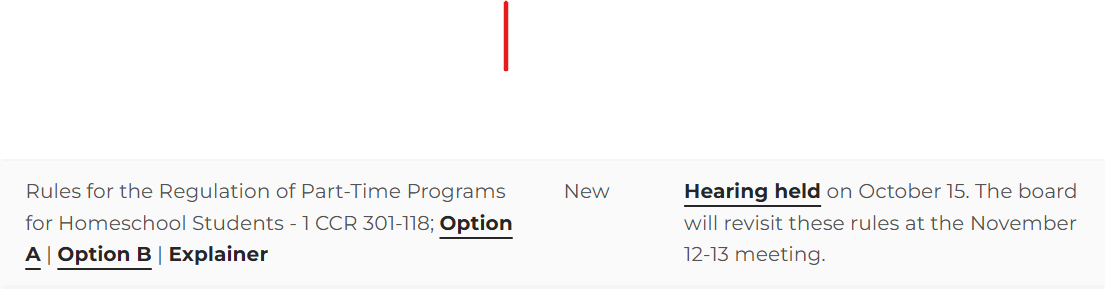
In that picture you'll see some live links to CDE's option A rule, option B rule, and an explainer. For your convenience, I put links to those three (in that order) below.
Lastly, if you scroll down in the second link (CDE's rulemaking page) you'll see what I attach as screenshot 2, the different ways you can get involved.
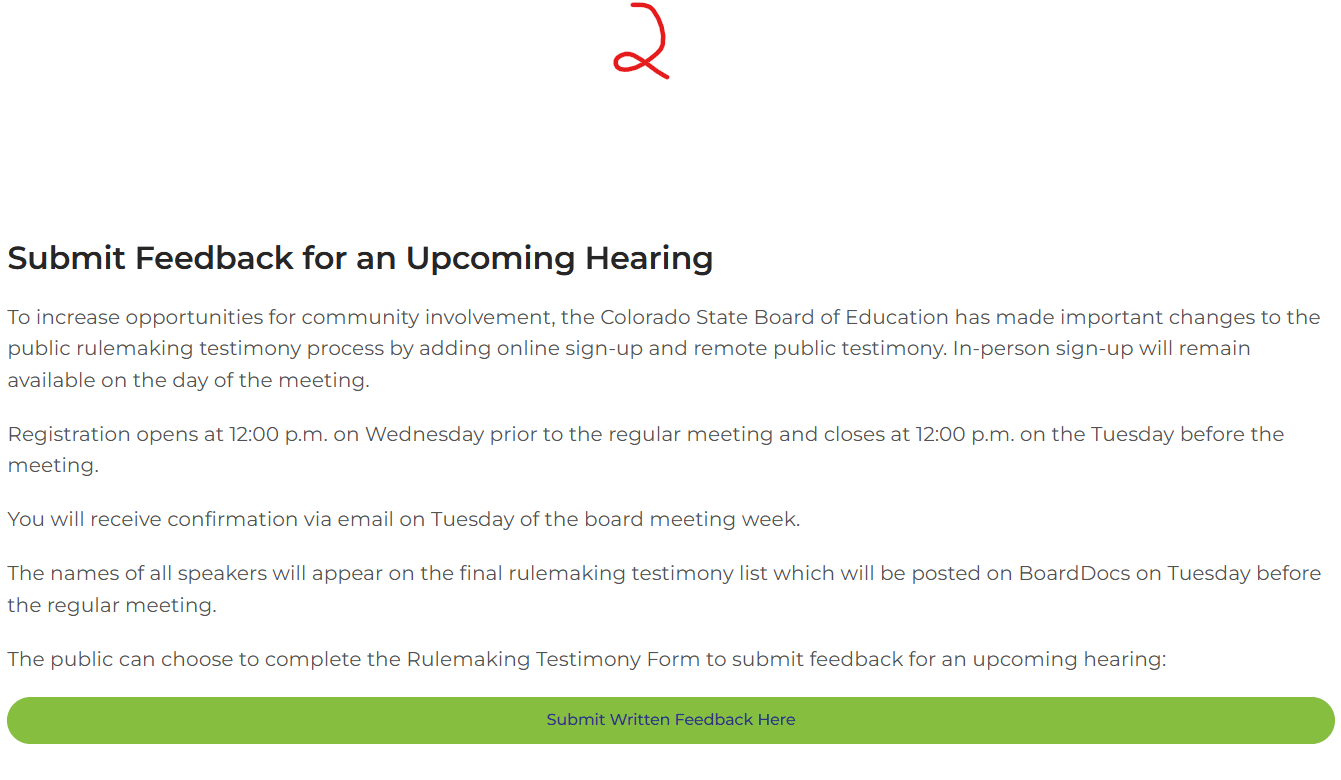
You can attend the November meeting, but I'll be honest, I'm not sure what and how much discussion will happen then. Given that, I think probably that it would be best to send written comment.
If anyone else reading knows better than I do about whether or not public comment is taken or useful at the November meeting on this issue, please add to the comments for the benefit of all.
https://www.chalkbeat.org/colorado/2026/10/09/state-decisions-on-home-school-enrichment-and-new-rules/
https://ed.cde.state.co.us/cdeboard/rulemaking
https://cde-state.community.diligentoneplatform.com/document/0b412d4d-6095-4d05-96e9-4dfd9f06a0a5/
https://cde-state.community.diligentoneplatform.com/document/89656b38-a36d-482e-8d84-0468c09afbc3/
https://cde-state.community.diligentoneplatform.com/document/efcb1846-eabb-4f78-9623-c0632ba5d894/
I realize I'm just an ignorant parent. I was thinkin' it'd be easier to go back to havin' the parents be responsible for preparing our kids for life. Then we could just use that chopping block to get rid of the executive committee altogether. What, exactly, is a "Homeschool Enrichment Program" anyway? Wait, let me guess. I bet it has something to do with taxpayer dollars appropriated into grant money to be awarded to qualifying NGO/NPOs; for the children.
Huh, I wonder what would happen if a special prosecutor requested the meeting notes from the attorney-client discussions. Allegedly, PUC said they were going to close those meetings.
Colorado's Open Meetings Law (C.R.S. § 24-6-401) requires that public policy formation be conducted openly, but allows closed-door executive sessions for specific purposes such as attorney-client privilege discussion.
Smith, J. (2026). Open meetings and public utilities: Understanding closed-door sessions. Colorado Law Review.