
The Sleeper Effect: Know Your Brain and Don’t Let Yourself Be Manipulated. Did Senator Roberts and Polis take the same seminar or something?

The Sleeper Effect: Know Your Brain and Don’t Let Yourself Be Manipulated
Human beings have a whole lot of in-wired faults with our reasoning. I’ve often thought that a good way to view science was as a process designed to skirt and prevent the kinds of bad thinking that would come naturally if we’d let it. You could say the same for the kinds of tools that come in the “skeptics toolbox” (see the first link below): a great set of techniques to help boost your critical thinking.
I like to share these things with you not only because I find them interesting, but also because avoiding manipulation and bad thinking is important to us all. I have a new one to share that came from watching something about the psychology of learning recently.
It’s called the Sleeper Effect. I put a link to a Wikipedia page second below if you want another resource and jumping off point, but in summary it’s not too hard to explain.
Human beings have faults not only with encoding information, we can also sometimes be bad and remembering the source of what we learn. You might remember the statistic or fact, but (especially if you’re young, or old, or if a lot of time has elapsed) you might not remember where you learned it and from whom.
That bit about cured meats causing cancer? You filed it away 6 months ago, but when you’re talking with a friend and casually mention it, you may not remember whether you saw it on a Facebook reel or whether you saw it as part of a group of studies on the Mayo Clinic website.
You initially saw both, but only one (the factoid) got stuck in there and it lay dormant, sleeping til something made you toss it out to a friend over coffee. If asked, you probably won’t remember who said it.
The problem is obvious. Not all information can be weighted equally; the Mayo Clinic, while perhaps not perfect, is more likely to offer dependable information backed by research as opposed to the yoga influencer who might be passing something to entice you into buying their online course about avoiding cancer.
At the very least, you as the purveyor of information, and your friend as the receiver should both be aware of where the information came from.
I have an example of how this plays out in our media. The third link below is to an earlier newsletter that went into detail on the source of “The Science” a CPR reporter blithely forwarded along in her article on coated seeds and the bill to make it harder for farmers to use them.
When I backtracked there was a whole lot of questionable research in “The Science”, and it was almost certainly a case of the CPR reporter being handed a package of studies by the environmental advocates at the National Resources Defense Council, a group pushing the bill.
The fourth link below is to another CPR article that was a follow up on the failure of the bill about coated seeds. Reading it, you’ll note that a different reporter at CPR wrote it, but just as thoughtlessly quoted the same studies.
Just as in the first article, no mention of the source of the studies. The snowball is small but growing.
Fast forward 6 months from now. Do you imagine that a casual reader, even assuming he or she followed the links and looked at the research which the reporters gave, will remember that the source of the info? The groups pushing it?
If I had to bet, I’d put my money on them tossing something like “Oh, speaking of which, I read somewhere that coated seeds kill bees and they really don’t help farmers have better crops”, while the rest of the table nods and the conversation moves on.
Witness the promotion of shoddy, questionable research. Witness the birth of a new “truth”.
If keeping your mind your own is important to you (as it is to me), I have a suggestion. When you hear things, ask where the teller heard or read it. If he or she doesn’t remember, make a point of writing yourself a note and looking it up on the internet later.
If you’re the teller of a fact that percolated up to your consciousness, and you don’t remember where you heard it, make a point of saying so. Make a point of following up on that uncertainty later. Or, choose not to share non-trivial things if you don’t remember the source.
Sender, or receiver, the best antidote to the Sleeper Effect is to wake up your brain. Put conscious effort into finding the source of the information you encode.
Protect your thoughts. There are plenty of people and groups out there who would love to manipulate you and they know all about the pitfalls we humans are subject to.
https://centerforinquiry.org/skeptics-toolbox/
https://en.wikipedia.org/wiki/Sleeper_effect
https://www.cpr.org/2026/02/27/bill-control-pesticides-dies-statehouse/

Did Senator Roberts and Polis take the same seminar or something?
The main purpose of this post is to show you a handy online tool you could use to follow the legislature and/or legislators, but I'm going to take the scenic route getting there. If you don't want the tour, skip to the third link at bottom and poke around in the Umbrella online tool.
Returning to Senator Dylan Roberts. I have had more than one conversation with people about him, and have seen more than one article profiling him or his actions, with the general theme of how he pushes back on the Polis administration or how he stands up for agriculture.
While I don't disagree that he has, on certain occasions, given Polis a love tap or two, it's important to get a broader perspective.
Roberts is, after all, a politician in the same mold as Jared Polis: he has the habit of saying one thing to one group and something else to another. The media for its part, with their habit of paying outsized attention to controversy and argument, has also played up the minor disagreements Roberts has had with Polis more than the times they align.
I offer as an example, the first and second links below. The first link is to an earlier newsletter where I excerpted a quote from Senator Roberts after he voted down the ill-conceived coated seeds permission slip bill.
There is a quote in that newsletter worth repeating here:
"To opponents of SB 65, Roberts said the issue [of pesticides and/or coated seeds] isn’t going away."
The second link below is to the equally ill-conceived bill about eliminating rat poison. This one (after amendments) got Roberts' yes vote. See screenshot 1 attached.
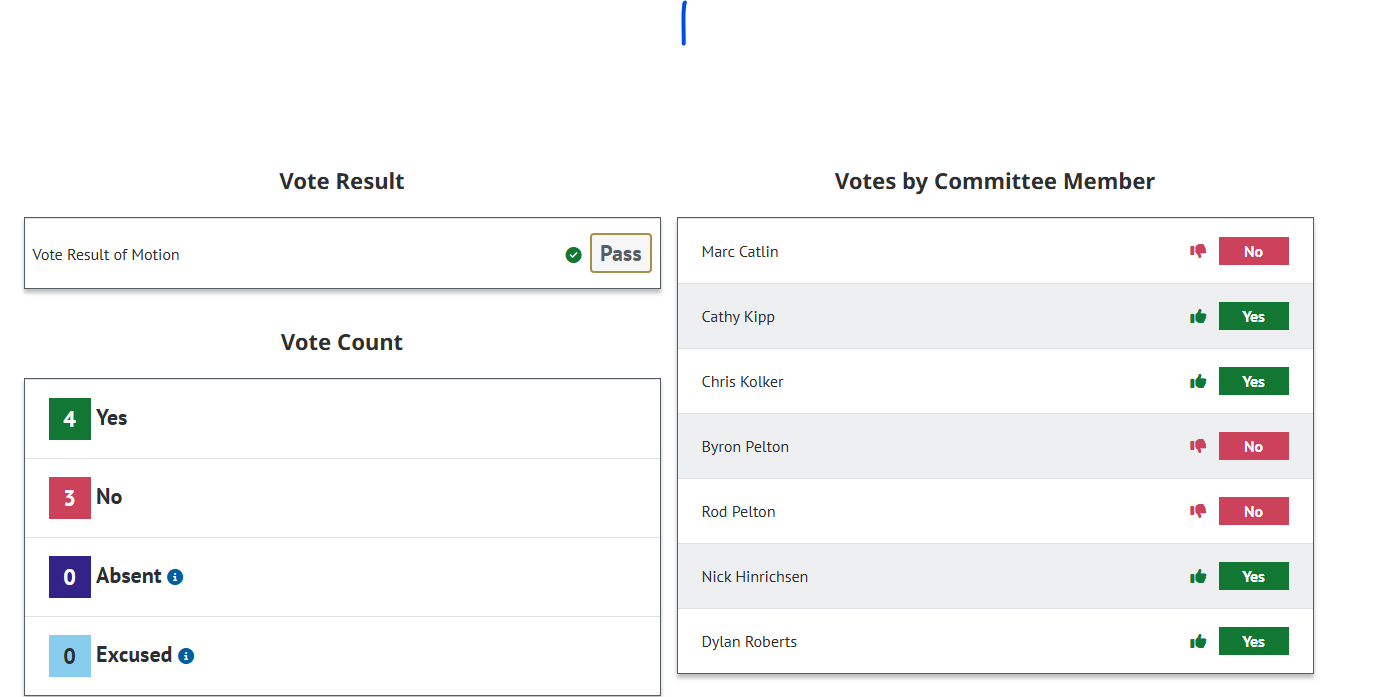
I bet you money that Roberts, like Polis, would say if confronted about his vote here say that he got them to tone down the bill. He “softened” it by agreeing to it. Similar to how he “softened” the gun control bill.
Lastly, and I don't have a link to back this one up just what readers have told me, I have heard stories that Roberts initially told his constituents he was going to vote against last years government permission slip to exercise your 2nd Amendment rights SB25-003.
And then he voted for it, citing (and this is also a Polis move) an amendment he supposedly forced onto the bill allowing certain old and little-used firearms to be excepted from the bill.
This brings us (finally) back to the start of this post and the legislative tracker.
If you are reading widely you have a good start on not getting a misapprehension about this or that politician. I think the best thing you can do, since actions speak louder than words, is to follow any given legislator's votes.
Does Roberts support Ag? Does he believe in gun rights? How often is he in line with Democrats vs. opposing them?
The good news is that this job is made much easier by using a tool a reader shared with me called Umbrella Civic. That is the third link below.
There's a lot more to this tool and I invite you to poke around and/or add to the comments if you find a feature there that you thought useful, but I will focus on the legislative voting record.
Scan across the top to the "Legislators" tab and click there. The first thing to populate is a chart that lets you compare how often any given legislator votes with or against their party on some of the major issues.
Scrolling further down takes you to the legislator tabs. Clicking on Senator Roberts' tab opens what you see in the fourth link below, his overall voting record with various filters you can apply.
Given that this state is run by Democrats and the high (HIGH) percentage of YES votes for Roberts, I think it's a bit early to label him any kind of moderate, centrist, or friendly to anything outside of Democrat priorities.
https://open.substack.com/pub/coloradoaccountabilityproject/p/a-lost-opportunities-tracker-for?r=15ij6n&utm_campaign=post&utm_medium=web&showWelcomeOnShare=true
https://leg.colorado.gov/bills/SB26-062
https://www.umbrellacivic.com/guide
https://www.umbrellacivic.com/legislators/roberts_dylan