
Seeing an “affordable housing” project from the inside.
I wrote about a project to build so-called affordable housing on a weird little quadrangle of land up near Golden, the Golden Range project. The newsletter from March of this year is linked first below if you’d like to go review.
After talking to their media person, I set a reminder to follow up later in this year to see about any new developments. The project was just in its infancy when I wrote about it before.
If it was in its infancy in March, it’s now in its toddlerhood. We are still a long ways from the end, but I have some updates to share. As the title of this post suggests, this will be one of multiple updates on this project; its a great example of how affordable housing is getting done in Colorado, and it’s one we can watch from the beginning.
The project has been put out in public for proposals from interested developers. I’m not sure how many came back, but the proposal that is in negotiations right now with the Public Private Partnership, P3, office (the government department running it) is linked first below.
This is a big project and there is a whole lot here, more than I could cover in a single post. As such I’m going to give some quick broad strokes on the proposal as-is, focusing on how (in the developers’ minds) the public entities are in the mix.
Golden Range is meant to be a mixed neighborhood, it will have homes and rentals from 30% to 120% of the AMI (Area Median Income--a metric used to rate housing affordability). There will be a mix of row houses, duplexes, apartments, for sale and for rent.
I took a picture of the community plan and attach it as screenshot 1.
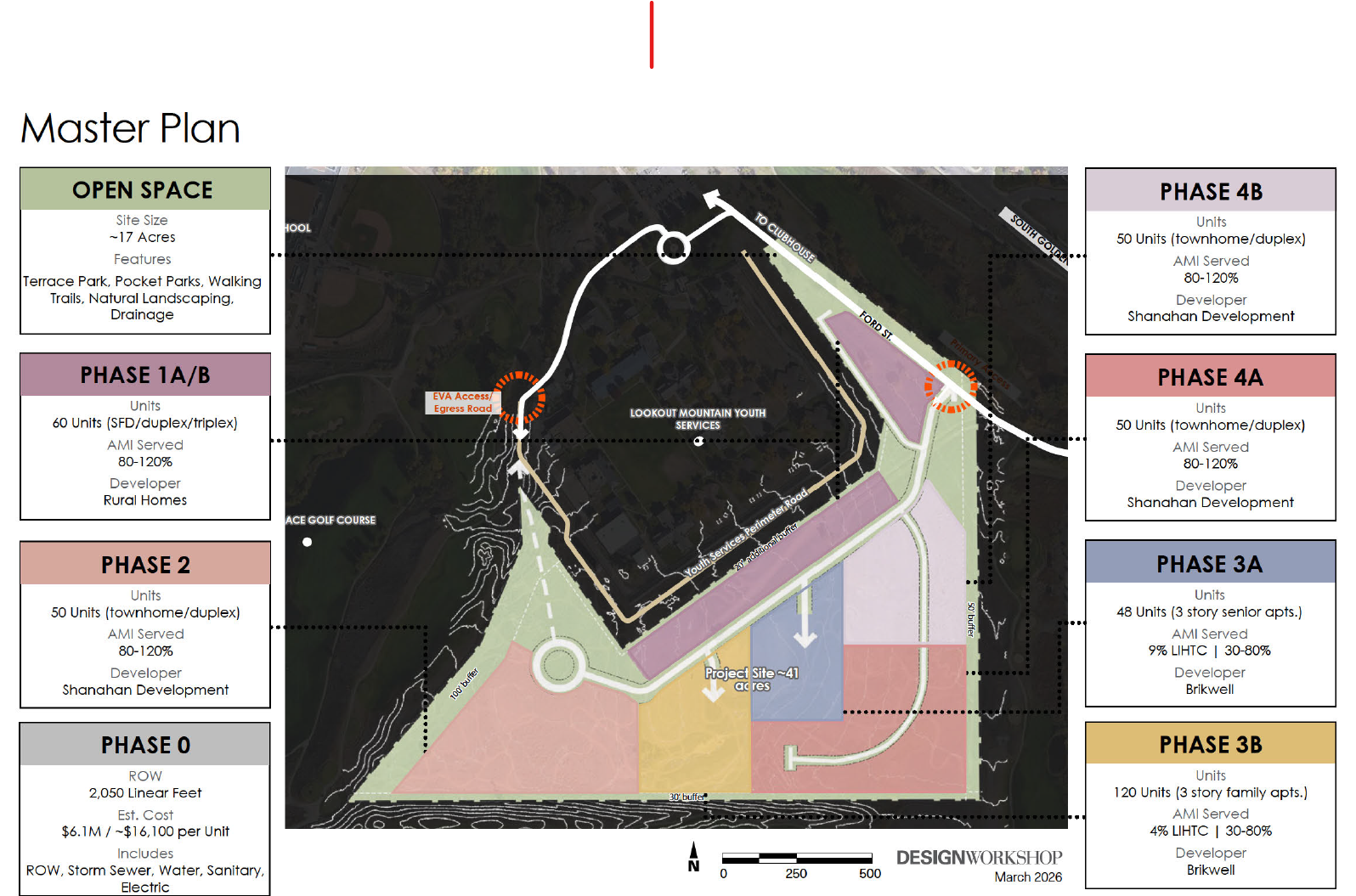
To help you understand what I mean, consider phases 3 and 4b. They are right next to each other with the former being 3 story apartment blocks financed in part by Federal Low Income Housing Tax Credits (among others--see below) going at 30% to 80% of AMI. The latter is townhomes and duplexes at 80% to 120% AMI. You will notice that none of the housing is listed as freely priced, as being at market rate. If you do as I did and look at the various contractors for the various phases, you’ll note that none of them are (at least not exclusively) what I would call market rate developers. They are the kind that occupy that curious niche where they’re a private company, but they sell their services to charities and the government to build (sometimes manage) below market rate housing.
To get a private company to do something, they’re going to want to make money. No reason to do it otherwise. I don’t think that the developers here are different. They might be selling to a different end customer, but they still want to make money. They can’t compete with other private developers selling at this rate, so they look elsewhere to help them sell cheap but still make money.
Enter the State of Colorado and the City of Golden. Well, perhaps, I should say enter the taxpayer. Ultimately you are paying.
This project sits on state-owned land. State-owned property is legal to sell to a private business at fair market value. Selling the land that way would eat into developer’s bottom line, so we have to avoid that.
Why not give the land to the developer? Land is one of the biggest costs of housing here, and they’re doing God’s work, after all. While I’m sure there are some in the government who would love (LOVE) to simply give over state property to affordable housing, it’s complicated That pesky state constitution severely limits what the state can do for private companies.
There’s a reason why the P3 office is handling this. One way around the law is to have the state lease or transfer property for a “public purpose” and the P3 office is great for that.
Screenshots 2 and 3 show the two-step the developers are proposing.
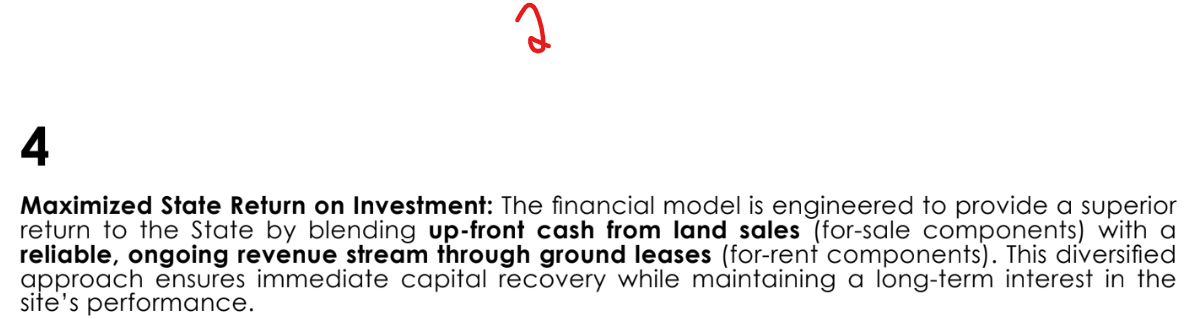
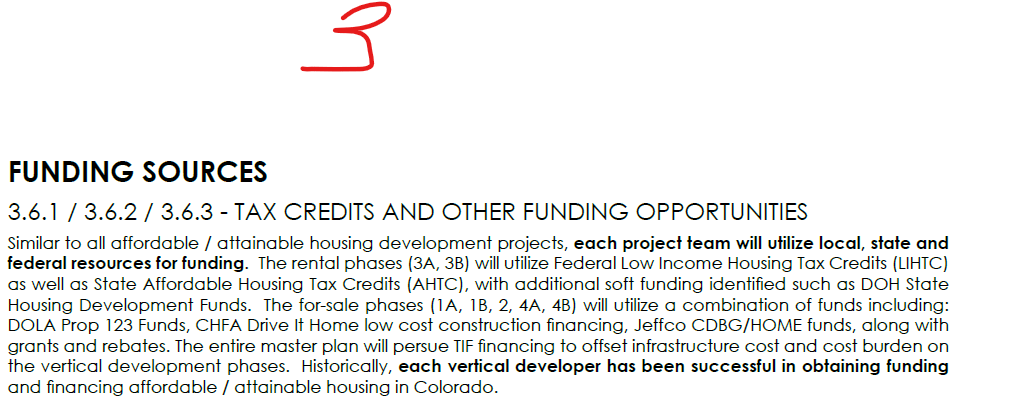
A combination of federal, state, and local (JeffCo) grants and loans (on very favorable terms to the developer) provides money for the developer to buy the land and start construction. As homes are built and sold by phases, this money goes back to the state to pay for the land they would buy.
In the case of rentals (applicable to the rentals and those that might sit on state-owned land), no property changes hands at all. It’s just rented on a long term (99 year) lease.
One more time in brief, stripped of PR language like that in the report. The state gives and loans money to the developers (on generous, below-market terms). The developer buys the land from the state, builds on it, sells the houses, and keeps the leftovers.
At the same time, for some housing, the state will rent the land to the developers. Developers will build on it. The affordable housing/development company (see “Related” below) will rent and manage and pay money back to the state. You might own the building, but the land its sitting on still belongs to the state.
Cozy.
Doesn’t end there, however.
Screenshot 4 shows how Golden itself is going deep on this project.
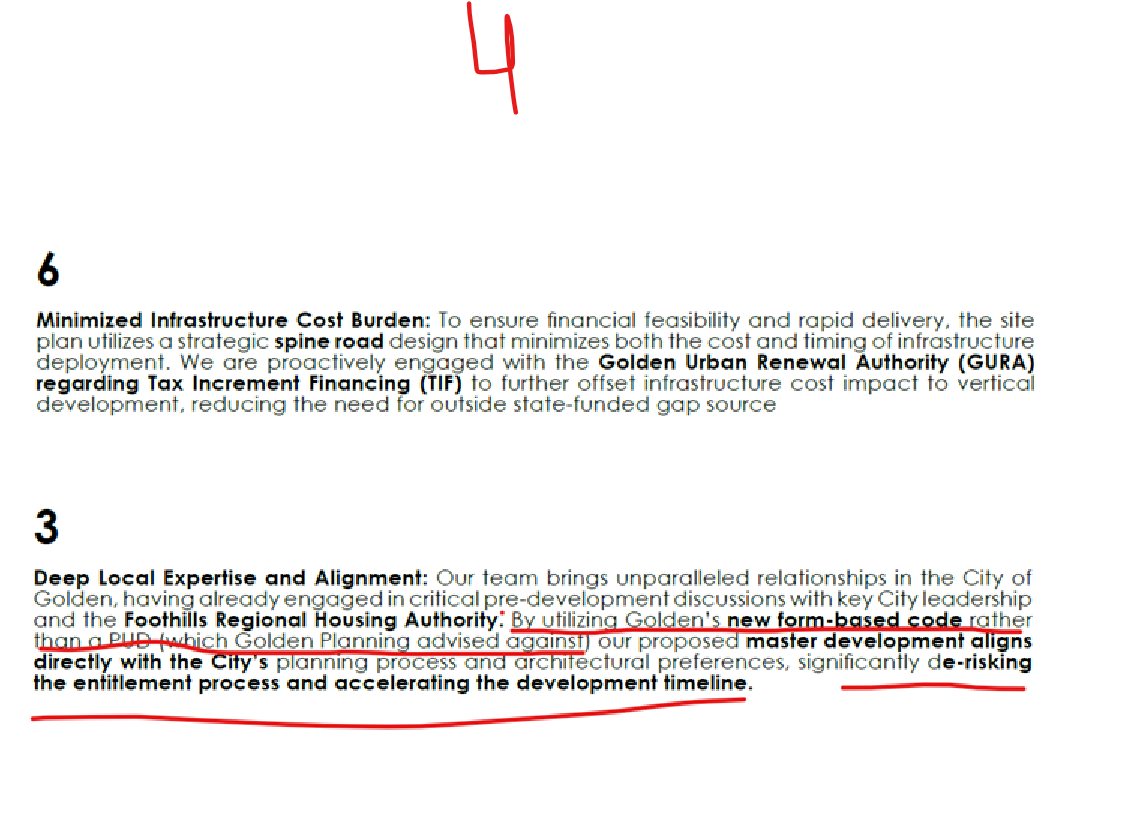
Another big cost driver on development is all the background work you must do to build. You have to grade the site, develop ways to manage runoff, run water lines, run sewer lines, run power lines, etc. This can be an implicit cost hiding in the price of a home, this can be (at least partly) financed by the creation of a metro district, or, as the developers for Golden Range wish, it could be via Tax Increment Financing (TIF).
I have written about TIF before, so I won’t go into a huge amount of detail, but you can think of it similar to a gamble. The government gives the developer a tax break on property taxes as an incentive to build something on land they want developed. The bet here is that the increased value of the land on which the developer builds, when they do pay taxes, will more than pay off the break they get now. Thus the PR message that the development is paying for itself.
As any reasonable thinking person can figure, revenue for city services doesn’t stop because we wish it to. In fact, it’s likely to increase with more development. That shortfall in revenue has to be made up. It gets made up by taxpayers, and by shorting the surrounding districts. Others pay more, at least in the short term, so the developer gets a break.
More picking winners and losers, just like blessing some of them with tax credits when they build what the government wants.
If you want to read up more on TIF’s, see the third and fourth link below. The third is an older Complete Colorado article dating back to the halcyon days of yore when a Boulder Democrat in the Colorado Assembly wanted to pump the brakes on TIFs. I know, hard to believe. The fourth being a legislative council staff article on the impact of TIFs on school funding.
I hesitate to add more to this post, but I can’t not include what you see in screenshot 5.
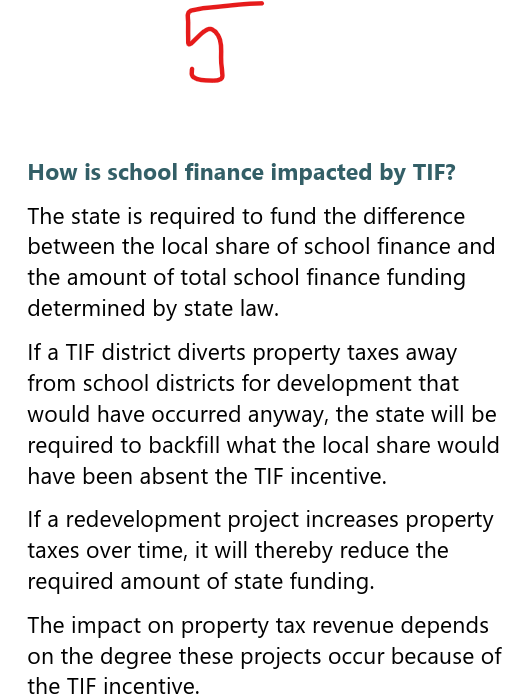
It’s a quote from the report on TIFs and school finance. When you hear about financial mismanagement from your government, this is yet another example. TIFs are great ways to rob Peter and pay Paul.
When you fund affordable housing with TIFS, other local governments (such as school districts) can face a shortfall of funding, funding which the state then must backfill.
Lastly, I want to point you to the other half of the fourth screenshot.
Zoning and land use are a big question mark for developers. Question marks aren’t good because those that lend money and/or give grants to developers (including the government) don’t like risk. Over and over in this report, you see how the developers stress their experience and ability to get projects done. This is how you assure the decision makers that you’re the right one for the job.
If the zoning process were to fail, or face delays, this could derail the project. Golden was kind enough to guide them through the zoning process, however, to help grease the skids. In 2025, Golden finalized their newly-drafted Form Based Codes for zoning, and they’re offering this easier pathway to approval to the project. One wonders if all developers and landowners up there get such kind attention from the city. My guess is that traditional developers won’t, because from some preliminary research, Form Based zoning is meant to help make developments like Golden Range easier.**
This proposal is far from final. As I said at the start, we’re only in the toddlerhood now.
I think you can probably guess my feelings and concerns about this by now. I don’t like the government stepping this far into the housing market. That is not it’s job; it’s doubly onerous that the way they go about it is to pick winners and losers, all on the backs of taxpayers. Nor am I wowed by the seeming newness of the setup here. Parts of this neighborhood, as outlined in the proposal, would be “The Projects” by a jazzed up name.
Whether you share my feelings or not, I want to end with this. There will be plenty of opportunities for you to weigh in on the process. If you live in or around Golden, watch for zoning hearings on this project.
This project will also ultimately have to be approved by the Capital Development Committee of the legislature. The committee webpage is linked fifth below. As of now there is no committee hearing because there is no agreement or contract between anyone. I have asked the committee to be put on their mailing list, so I will update as I hear.
I have also asked to see any ground lease agreements inked if the state does end up as the landowner on which the affordable housing is built. Any such lease comes after legislative approval so that one is also filed under “I will update as I hear”.
In the meantime, I want to end the day with a second post on what history can teach us about the government owning land on which you live. See you in the second post.
**For clarity, I do not say that Golden adopted this specifically for this project. It part of the zeitgeist in Colorado in my view. Expect more on Form-Based Codes in the future, including how the state is creeping in on local land use decisions and laying the groundwork for development like this. In the meantime, I offer a Wikipedia reference on it fifth below.
https://drive.google.com/file/d/1ObsQXWyotqfiQAZ2kt9umHKtpNG9ZNTV/view
https://completecolorado.com/2013/10/05/tif-brewing-between-general-assembly-and-local-governments/
https://content.leg.colorado.gov/publications/impact-tax-increment-financing-school-finance
https://en.wikipedia.org/wiki/Form-based_code
https://leg.colorado.gov/committees/2026A/year-round/CapitalDevelopmentCommittee
Related
I have written in the past about a niche in the homebuilder market that exists for "affordable housing" developers to capitalize on government projects and government money.
I.e. a private company but one that feeds off government money mostly, as opposed to one who sells to private individuals.
One of the developers in the Golden Range project Birkwell (see the link below) appears to be just such a company. Quoting from their About page:
"Through partnering with public entities, housing authorities, non-profits and private investors, we leverage our knowledge, financial capacity and partnerships to deliver exceptional results."
If Colorado moves more into the affordable houses = publicly funded houses, expect more companies like this to be here.
Oh, and don't forget: if the government is the customer, you are not.
https://brikwell.com/about/

What does history tell us about living on land the government owns?
One of the things I covered in the prior post about the Golden Range Project was the proposal that, for some of the apartments and/or houses, the State of Colorado would retain ownership of the land underneath the buildings, leasing this land to the owner/manager of the building via a long term lease.
As I noted in the prior post, this is a long way from reality and I will update if I get any more to share about that.
But when I read this, it struck me that government ownership of land on which people live is not unheard of. In fact, some Indian tribes have more experience with this than they'd like. I think sharing some part of their history is important as a cautionary tale for those that would like to do it in miniature here in Colorado.
The idea behind the land being owned by some beneficent group (government or nonprofit) is based in the assumption that any building in private hands could end up being sold and/or converted to market-rate units.
This rationale is clearly evident in screenshot 1 attached (which was used as an example of successful development by one of the groups proposing to build the Golden Range project in post 1--for convenience's sake, I link to that proposal first below).
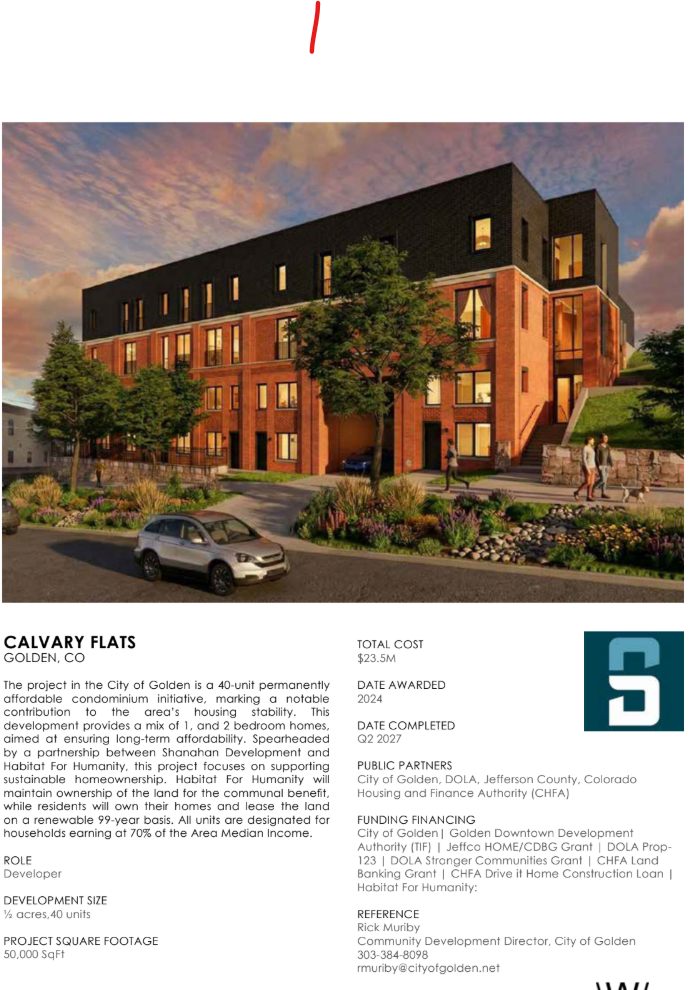
If the Golden Range project proceeds as mentioned in the proposal, you can copy/paste the above but insert the State of Colorado in place of Habitat.
American Indians, for a long time and for many tribes have struggled with poverty. Coincident with that, they have lived on land held in trust for them by the Federal government.
Many see this as part of the reason for Indians' struggles. To help give you some background on the topic, I point you to links 2 - 4 below. The first is to the US Department of the Interior's site on the benefits to Indians of taking any land they own outright and putting it into trust with the Feds.
There are indeed some advantages there, but if you look at links 3 and 4, the first a blog post by the group PERC and the second by the US Bar Association, you'll see there's more to the story.**
I'll leave it to you to read up on both, but I think it's reasonable to sum up the problems thusly: when you don't own a resource, you don't control it, and you cannot use it to help you improve your condition.
Indians forced onto reservations are obviously not the same as those moving into houses (and/or buying same) on land they don't own, but similar hazards and incentive structures exist.
If I don't own the land under my house, I don't fully control my life. If the state owns the land where I rent, and the owner of the building disappears or gets into financial trouble, what then? What about the added layers of bureaucracy involved any time you get the government mixed into things? To get anything done will you have to have the patience of Job while the government figures it out?
Besides those practical issues, what are we really after here? This too echoes older, paternal policy towards Indians by the Federal government. Quoting from the third resource below with the embedded link intact:
"Chief Justice John Marshall set Native Americans on the path to poverty in 1831 when he characterized the relationship between Indians and the government as 'resembling that of a ward to his guardian.'”
If we provide housing but maintain control of the property, what have we done? Have we moved our state into a relationship with those in lower income brackets "resembling that of a ward to his guardian"? Have we helped people move toward self-sufficiency? Isn't that the point here? Surely there are some unable to care for themselves, but the rest ought to, no?
Perhaps we ought to re-evaluate what we are doing and reconsider it through the lens of helping people attain self sufficiency rather than maintaining governmental funding sufficiency.
Perhaps we should learn from history and not make similar mistakes as we have in the past.
**In reading PERC's About page, it becomes somewhat clear that they would love to be able to help Indians capitalize on the natural resources on the Indian's land. I.e. they got a dog in the fight. Keep that in mind as you read. I would not have included theirs were it not echoed in other places. Also, just so its said, I don't buy into the ABA's social justice stuff whole hog either.
https://drive.google.com/file/d/1ObsQXWyotqfiQAZ2kt9umHKtpNG9ZNTV/view
https://www.bia.gov/service/trust-land-acquisition/benefits-trust-land-acquisition
https://www.perc.org/2014/03/13/5-ways-the-government-keeps-native-americans-in-poverty/
https://www.americanbar.org/groups/crsj/resources/human-rights/archive/federal-policies-trap-tribes-poverty/
Thank you again for an outstanding article. The problem you so wisely pointed out is that we usually help people into dependency. The Indian illustration is an excellent illustration. Charities do it, our government is a pro at creating dependency, enabling parents, etc.
I am glad I am so old and won't have to see much more of this. Just know so many agree with you.
Many blessings to you,
J. Giles