
Difficult, but important things about Medicaid in Colorado.
I have a two part post today on the subject of Medicaid. I will tell you now, they’re difficult to wade through, and this is only a tiny corner of our state’s program.
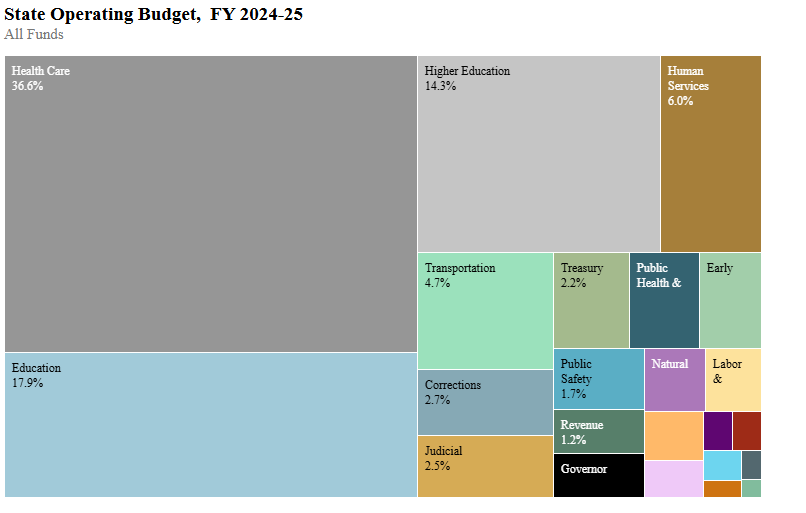
They are also important. Colorado’s Medicaid system is one of the biggest drivers of our state’s budget and you need to pay attention to it so you can join the conversation. What we do with Medicaid in this state will help either keep Colorado above water or sink it; it is that big a budget item (see the image above).
As I say, what you’ll see here will be tough and will be but a tiny bit of a large and complex system, but every little part you learn will help you be a better, more informed citizen of this state.

Untangling a (rather hefty) reader statement about Medicaid.
Be forewarned, the government programs and acronyms pile up fast here. I'll try my best to get around that, but read carefully and slowly.
It's been a while because it's taken a while to learn it, but this post is in response to a reader comment about combining some of Colorado's Medicaid services under one banner. Before we can touch on that, however, we have to do some prerequisite work first.
A Medicaid waiver seems at first to have no connection to what it actually is, but if you stop and reason it out, the word makes sense. Remember that Medicaid is a program that is run by states, and the states partly fund it. The feds also fund Medicaid via matching dollars. As you might expect, the feds put rules on what they'll fund. Any state can fund and do nearly anything it likes; for example, Colorado funds medical care for illegal immigrants. This isn't allowed under federal rules, but as long as Colorado doesn't use federal money for it, it's legal.
If a state would like to use federal money for some program, they can apply for (or sometimes the feds offer) a waiver of the normal federal Medicaid reimbursement rules. So, when you read about Medicaid and waivers, what you're reading about is a federal permission slip to use federal money for any particular program.
Colorado has plenty of waivers and the one I want to discuss in this post today is called the Home and Community Based Services Waivers (HCBS Waiver from here forward). The HCBS Waiver has been around a while and, as its name suggests, allows the state to use federal money to help pay for someone to get care in their homes or perhaps in a community setting instead of needing to be institutionalized. The first link below is for this program.
Quoting that page, an HCBS Waiver is "...an extra set of Health First Colorado (Colorado's Medicaid program) benefits that you could qualify for in certain cases. These benefits can help you remain in your home and community. HCBS Waivers have extra program rules and some programs may have waitlists."
There are several different types of HCBS Waivers you can get, but I picked on and included a summary table from the site for you to see. Screenshot 1a is the summary table for a particular type of HCBS Waiver service you can get. Screenshot 1b explains the acronyms at the top right of the table.


As I mention above, HCBS Waivers have been around for a while. From what I can find online, Colorado was one of the first states to offer such extra services, dating back to 1983 and growing ever since. For some background on the Federal law that allowed such programs, check out the second link below. The rationale is in line with the posts from yesterday about early childhood policy recommendations: it’s cheaper and better for the people involved.
I have less doubt about the cheapness of this kind of waiver than I do about the early childhood recommendations from yesterday, though. Institutionalized care is incredibly expensive. You’d have to have a huge bill for home care to come close. In addition, knowing what I myself would want, I imagine that being around family would lead to better health outcomes. Medicine always focuses on the human organism as machine, too often ignoring the interplay of mind and body that has health consequences.
The HCBS Waivers might not be new, but something is and this is what the reader had commented on. The Colorado Department of Healthcare Policy and Financing (HCPF--hereafter I will label it “the Department”) moved some other programs into the HCBS Waiver umbrella.
The third link below is to the Department’s Community First Choice (CFC--hereafter First Choice) Option page. In one sense, First Choice is a new name and new organization for existing programs. In another sense, it’s an expansion of who can get different kinds of care and a way to draw down more federal matching money. Quoting from that page:
“Community First Choice (CFC), also known as 1915(k), is an optional Medicaid program that allows states to offer select home and community based attendant services and supports to eligible members on the State Plan, expanding these long-term care services to more Health First Colorado (Colorado’s Medicaid Program) members.”
Let me reiterate since it’s easy to get lost in the all the programs. That last sentence above has it. Rephrased, it’s saying that they’re expanding coverage options.
Before expanding on that, I need to now mention a couple other things. I told you there was going to be a lot here. Earlier, when I said a reader commented about Medicaid programs, the two things they mentioned were Consumer-Directed Attendant Support Services (CDASS -- hereafter called Consumer Directed Services) and In-Home Support Services (IHSS -- hereafter called In Home Services). Links for these programs are listed fourth and fifth below respectively.
In addition to reading on my own, I reached out to The Department’s spokesperson with some questions, in particular the way that long-term care programs were combined and why. Quoting from the statement I got back (with links intact):
“Colorado implemented Community First Choice, or CFC, on July 1, 2025. CFC did not combine Colorado’s Home and Community-Based Services waivers, Consumer-Directed Attendant Support Services (CDASS) and In-Home Support Services (IHSS) into a single program. Instead, CFC is a Medicaid State Plan benefit (existing under a 1915(k) waiver authority) that makes certain long-term services and supports available to eligible Health First Colorado members outside of a traditional HCBS 1915(c) waiver. CDASS and IHSS are service-delivery options available through CFC for certain services, including personal care, homemaker and health maintenance activities.”
“An eligible member does not need to be enrolled in an HCBS waiver to receive CFC services. Members must meet Health First Colorado eligibility requirements, meet the applicable institutional level-of-care criteria (i.e. Nursing Facility or Hospital), and have an assessed need for the service.”
“Members who also qualify for an HCBS waiver may receive CFC services alongside other waiver-specific services, as long as the services are not duplicative. CFC does not replace existing Colorado’s HCBS waivers, which continue to provide services that are not available through CFC.”
“Colorado pursued CFC to expand access to home and community-based services, increase member choice and opportunities for self-direction, and make more effective use of federal Medicaid funding. CFC also provides Colorado with an additional six percentage points in federal matching funds for qualifying CFC services.”
and lastly,
“For many members who were already receiving personal care or similar services through an HCBS waiver, the change primarily affects the Medicaid authority under which those services are provided. Members may continue to receive waiver-specific services through their waiver while receiving qualifying services through CFC.”
Again, hitting the high notes, this is a reorganization that allows more people to access Medicaid services and it helps draw down more federal money for them. The HCBS Waiver has been around since forever, and, according to The Department’s spokesperson, the two other programs folded into First Choice have been around since 2022 or for two decades (for Consumer Directed and Home Services respectively). Nothing new here, just moving them around.
There is a lot to digest. You have an existing program/program category. The overarching idea here is to allow people to be cared for in homes or community centers as opposed to care in an institution.
On top of that, you have programs which allow people more choice in who delivers the care, and how they deliver it. This by the way is care that now moves beyond things like a nurse coming to your home to help you maintain a functioning airway, things medical. We are also talking about (if you look in the links) care that includes, for example, homemaking services--help in doing your dishes and preparing meals.
Another big theme here is one we’re all becoming more familiar with, and that’s extension of services to more people and trying to squeeze more money out of the federal government.
To me, looking in on things like this from the outside, I have to say it’s a mixed pickle. There are parts of this system that make sense (paying for home vs. institutional care), and parts that don’t (expanding care more and more vs focusing on how to make the current system sustainable).
The problem is certainly on the scale of the departments themselves.
In the second post today, a quick look at an asked-for and granted ruling from the federal government about payments for care and taxes.
https://hcpf.colorado.gov/hcbs-waivers
https://www.medicaid.gov/medicaid/home-community-based-services/home-community-based-services-authorities/home-community-based-services-1915c
https://hcpf.colorado.gov/community-first-choice-option
https://hcpf.colorado.gov/consumer-directed-attendant-support-services
<a href=”https://www.google.com/url?q=https://hcpf.colorado.gov/in-home-su
HCPF's Private Letter Ruling on payments to Home Care Providers
The last post was incredibly long. I'll keep this one short.
The previous post today was all about home health care and Medicaid paying for services. As part of reading up on that topic, I came across an interesting letter that the Department of Healthcare Policy and Financing (HCPF) wrote to the IRS.
Before continuing, let me give you some necessary background. A private letter (per the image heading this post and the IRS link first below) is essentially a letter you write to the IRS with a tax question. They respond to your question and their response can be taken as a guide for what you should do on your taxes (and your taxes alone, this is not a court ruling or binding precedent for any other taxpayer).
States and state government departments can also write private letters with their questions and HCPF recently wrote just such a letter to the IRS regarding the payments that HCPF is making to certain caregivers under their expanded homecare programs. The response from the IRS to HCPF is linked second below, and if you want to know more about our state's new (dating to July 2025) homecare Medicaid programs, see the previous post.
I'll skip the details (look in the letter and use Google if you want more), but the question boiled down to this.
If you are a live-in home caregiver, you get, under certain circumstances, what are known as "difficulty of care payments", that is payments made for the healthcare services you offer to someone you live with. Quoting from the HCPF glossary linked third below (don't let the "foster" throw you, it's not necessarily foster as in a foundling/orphaned/taken child):
"Difficulty of Care Payments is a payment to an individual as compensation for providing additional care to an individual who qualifies for foster care and lives in the home of the care provider. This additional care must be required due to a physical, mental, or emotional handicap suffered by the foster care individual."
HCPF wanted to know whether or not caregivers would have to report the money they get under such circumstances as income.
Per the IRS private letter, no. People in such situations do not need to declare any difficulty of care payments as income for tax purposes.
Right, wrong, or indifferent, so sayeth the IRS.
An important note: the spokesperson for HCPF included it (and it's all over their webpage on this topic), so I want to include it here. Quoting the response I got via email on this topic: "HCPF cannot provide individual tax or legal advice. ... Individual tax circumstances vary, and caregivers should consult a qualified tax professional regarding their specific situation."
https://www.irs.gov/tax-exempt-bonds/teb-private-letter-ruling-some-basic-concepts
https://drive.google.com/file/d/1Y3xqL2MZrGRI7guZD_JMDNmVS28CBcLq/view
chrome-extension://efaidnbmnnnibpcajpcglclefindmkaj/https://www.sos.state.co.us/CCR/GenerateRulePdf.do?ruleVersionId=6716&fileName=10%20CCR%202505-10%208.100

The All Stars of Fall Are Close to Blooming (Or Already Are)
That time of the week again. This’ll be the last post til Sunday and thus it’s time for something for fun, something unrelated to politics.
I was outside in my garage early in the morning the other day and I happened to notice that a distinct lack of bird song before the dawn, no robins singing, no kingbirds chattering away. Plenty of crickets though.
It was a reminder (if having to restart the school semester wasn’t) that Fall is nigh. I’ll miss summer, but a silver lining is that my Fall bloomers will be going soon.
I lost one of my black eye susans, but as you can see in picture 1, the other one is doing well. I am trying to decide if I want to divide this one, or get another one (or two, or three) to replace the one I have (and then put in other places around the yard. Such a cheery little flower.

Another is my liatris. Picture 2a shows a new one I got this Spring** and 2b shows my older, established one. As you can see, the ones I’ve had for a while are still waiting to bloom, but the newbies are already showing out.


Picture 3 shows my mum (red). It’s clear that it’s a ways from blooming. I’m not really seeing any nascent flowerheads start out. Soon, but not yet.

And lastly, another new one this year: my aromatic aster. Picture 4 shows the plants I have out front (have another out back). I bought them last Fall and transplanted. They bloomed just a little bit, obviously happy in their new home, so I’m really looking forward to see them in their bigger size full of blooms. The blue/white will be a nice contrast to the Henry Eilers pinwheels.

Fall may be coming, but there’s plenty of show before things are dead and gone.
That’s it for today. Hope you enjoy the last of your Friday. If you have some garden pics of your own to share, please add them to the comments!
See you back at it Sunday.
**On a trip to Wal-Mart in Spring I noticed their bareroot and dried plant display. Pretty cheap so I bought a few plants. Most did nothing except for the liatris. Had great luck with them. If you like liatris, you might consider looking for them at Walmart. The other nice thing about liatris is that, although they’re not technically bulbs, you can divide them like a bulb in Spring. Buy a few, let them grow a year or two, divide, repeat. Lots of plants on the cheap.